

In-Mold Labels Market Projected to Reach $4.9 Billion by 2035 as Recyclability Mandates Reshape Packaging Decoration
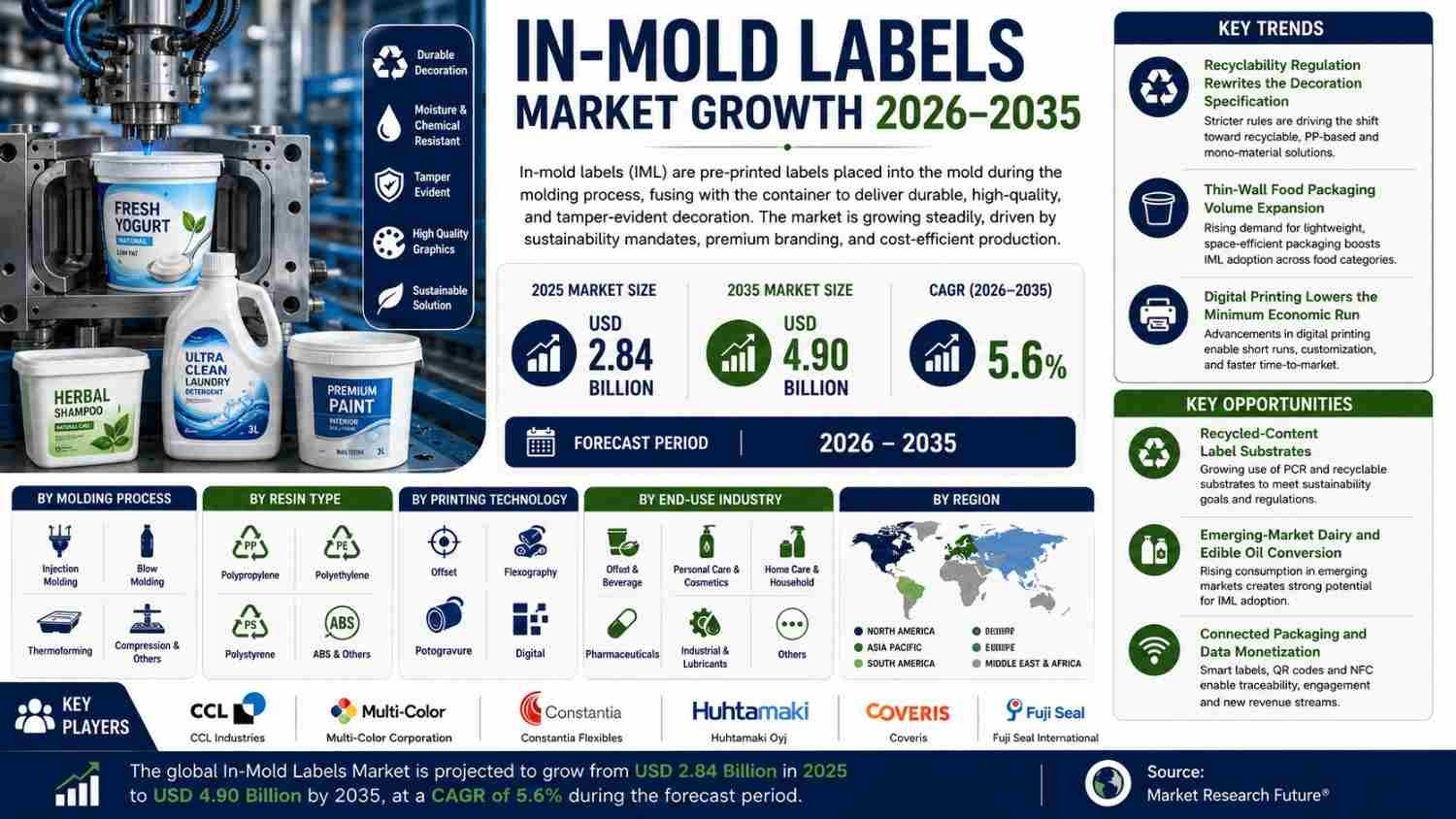
In mold Labels Market (2026 - 2035)
Pharmaceutical container decoration expands at approximately 6.6% CAGR on serialization and tamper-evidence needs.
CA, UNITED STATES, August 19, 2026 /EINPresswire.com/ -- The global in-mold labels market is entering a period of steady, structurally driven expansion. Valued at approximately $2.84 billion in 2025, the market is projected to grow from $3.00 billion in 2026 to roughly $4.90 billion by 2035, registering a compound annual growth rate of 5.6%. This growth is not merely cyclical; it is being propelled by a fundamental rewriting of packaging specifications across Europe, North America, and increasingly Asia, as regulators and brand owners alike pivot toward mono-material, recyclable-by-design containers. The shift is steadily displacing pressure-sensitive and shrink-sleeve decoration, both of which introduce foreign polymers and adhesive layers that complicate recycling streams.Regulation as the Primary Market Architect
The most powerful force reshaping the in-mold labels market is Regulation (EU) 2025/40, the Packaging and Packaging Waste Regulation, which obliges all packaging placed on the EU market to be recyclable by design from 2030. Under this framework, labels that leave a foreign polymer in the wash stream drag a container's recyclability grade downward, triggering direct financial penalties through modulated extended-producer-responsibility fees. In France, for example, eco-modulated schedules already vary by more than 50% between well-designed mono-material formats and poorly designed multi-material alternatives. The in-mold labels market benefits directly because a fused polypropylene label on a polypropylene tub survives flotation sorting as a single material, preserving material value and avoiding downgrades.
RecyClass design guidance issued in 2024 explicitly rewards mono-polypropylene construction, giving procurement teams a compliance-driven reason to move away from adhesive-bonded alternatives. As the OECD projects global plastics use will rise above 550 million tonnes by 2030, mono-material construction is transitioning from a sustainability differentiator to a baseline requirement, structurally favoring fused decoration over multi-layer alternatives.
Download Report Sample Copy: https://www.marketresearchfuture.com/sample_request/1790
Market Size and Forecast Trajectory
Market Research Future's estimates blend converter-level shipment data from label association reporting, polypropylene film resin consumption, and bottom-up modeling of installed injection and thermoforming capacity across 34 countries. Historical figures from 2021 through 2024 are reconciled against published packaging revenue disclosures and cross-checked with trade statistics for oriented polypropylene film. The market has grown from $2.35 billion in 2021 and is expected to reach $3.35 billion by 2028 before climbing steadily toward the $4.90 billion endpoint in 2035.
Segment Analysis by Molding Process
Injection molding dominates the in-mold labels market, capturing approximately 52% of global revenue in 2025. This dominance reflects entrenched use in thin-wall food containers, where cycle times and cavitation economics align almost perfectly with in-mold decoration. Injection molders running four- to sixteen-cavity tools at cycle times under six seconds need decoration that adds zero downstream steps, and robotic label placement inside the mold removes the labeling station entirely. Independent benchmarking across European converters found line-level throughput gains near 9% versus post-mold application, with combined labor, adhesive, and scrap savings of 12 to 18% per thousand containers on high-volume dairy and margarine lines.
Blow molding generated approximately $0.79 billion in 2025, serving home care and lubricant bottles where labels must survive surfactant contact that defeats pressure-sensitive adhesives. Thermoforming is the fastest-growing process segment, expanding at a 6.4% CAGR, tracking growth in single-serve dairy cups and prepared-meal trays. Compression molding and other specialty processes captured roughly 4% of the market, serving closures and niche formats.
Segment Analysis by Resin Type
Polypropylene is the structural backbone of the in-mold labels market, commanding approximately 64% of total share in 2025. Its dominance is not cyclical but architectural, since matching label and container resin is the entire recyclability argument that underpins the technology's growth. Polyethylene is growing at a 5.1% CAGR, driven by compatibility with blow-molded bottles. Polystyrene, valued at approximately $0.26 billion in 2025, continues a slow decline as European and North American dairy packers migrate away from the resin toward polypropylene alternatives. ABS and other specialty resins captured roughly 6% of the market, serving durable goods and industrial parts where decoration must withstand harsh environments.
Segment Analysis by Printing Technology
Offset printing remains the dominant technology, accounting for approximately 46% of the in-mold labels market in 2025. Its superiority in high-resolution photorealistic decoration for mass-produced dairy and food tubs keeps it anchored as the default choice for high-volume runs. Rotogravure contributed approximately $0.51 billion, particularly in long-run Asian food packaging applications where consistency across millions of units is paramount.
Digital printing is the fastest-growing technology segment, advancing at a 9.2% CAGR. UV inkjet and electrophotographic presses qualified for in-mold substrates have cut plate and setup costs to near zero, moving the breakeven run length from roughly 80,000 units to under 20,000. This unlocks sub-20,000-unit runs for regional SKUs, seasonal promotions, and private-label variants that previously defaulted to pressure-sensitive decoration. Flexography is growing at a 5.9% CAGR, occupying the mid-run cost-efficiency niche between offset and digital.
Buy Now: https://www.marketresearchfuture.com/checkout?currency=one_user-USD&report_id=1790
Segment Analysis by End-Use Industry
Food and beverage is the single largest end-use block, contributing approximately 41% of total demand in 2025. Dairy, spreads, and prepared meals account for the bulk of volume, with global thin-wall rigid container output growing roughly 4.8% in 2024. Home care and household chemical packaging generated approximately $0.44 billion, benefiting from the chemical resistance that fused labels provide against surfactants and solvents.
Pharmaceutical container decoration is the fastest-growing end-use segment, expanding at approximately 6.6% CAGR. The Falsified Medicines Directive verification requirements and comparable U.S. serialization rules push manufacturers toward decoration that cannot be peeled and reapplied. Label fusion is inherently tamper-evident, a technical advantage that has barely been marketed but offers significant potential as regulatory scrutiny intensifies.
Personal care and cosmetics are growing at a 6.1% CAGR, driven by premium finish requirements. Industrial and lubricants captured roughly 8.5% of the market, while other applications spanning horticulture, paints, and pet care accounted for approximately 9%.
Regional Landscape: Europe Leads, Asia-Pacific Surges
Europe holds the largest share of the global in-mold labels market at approximately 33.5% of revenue in 2025, supported by the deepest installed base of injection-molding decorators worldwide and the most advanced regulatory framework driving mono-material adoption. Germany alone captures roughly 24% of the regional share through dense dairy and spreads packaging activity. Italy contributes approximately 11%, serving confectionery and deli formats. The United Kingdom generated approximately $0.13 billion, anchored by chilled ready-meal container demand. France is growing at a 5.0% CAGR, propelled by its Citeo bonus-malus fee structure that has applied recyclability-linked modulation since 2023. The rest of Europe, including Poland and Turkey as emerging converting hubs, contributed approximately $0.28 billion.
North America ranks second globally with roughly 26% of market share, generating approximately $0.74 billion in 2025. The United States dominates the regional landscape with approximately 82% of North American revenue, driven by private-label grocery growth and state-level extended-producer-responsibility statutes in California, Colorado, Oregon, and Maine that begin fee assessment between 2025 and 2028. Canada is expanding at a 5.2% CAGR through dairy and prepared-food packaging. Mexico contributed approximately $0.09 billion as household and personal care fillers relocate closer to U.S. distribution networks.
Asia-Pacific is the fastest-growing region, projected to expand at a 6.9% CAGR through 2035. China accounts for approximately 37% of the regional share, supported by aggressive thin-wall food container output and domestic robot suppliers that have cut cell installation costs materially below imported equivalents. India is the standout growth market within the region at an 8.4% CAGR, as its packaged dairy sector expands at roughly 11% annually and edible oil packers migrate from pouches to rigid tubs for premium tiers. India's Plastic Waste Management Rules have tightened extended-producer-responsibility registration and reporting for rigid plastic categories, with obligations tightening through 2028. Japan contributed approximately $0.13 billion, focused on premium confectionery decoration. South Korea holds roughly 7% of the regional share through cosmetics packaging quality standards. The rest of Asia-Pacific, including Indonesia and Vietnam, is expanding at a 6.5% CAGR as capacity builds accelerate.
South America contributed approximately 6% of global market revenue in 2025. Brazil dominates with roughly 58% of the regional share through São Paulo and Paraná converting clusters serving multinational home care brands. Argentina is growing at a 5.6% CAGR through import substitution in converting, though currency instability lengthens capital approval cycles. The rest of South America contributed approximately $0.03 billion.
The Middle East and Africa region is expanding at a 5.8% CAGR. Saudi Arabia leads with approximately 26% of regional share, supported by Vision 2030 localization programs that offer financing support for packaging conversion investments and have drawn several European converters into joint ventures since 2023. The United Arab Emirates is growing at a 7.1% CAGR as a re-export food packaging hub. South Africa contributed approximately $0.03 billion through dairy and margarine containers. The rest of the region, spanning edible oil and detergent packaging across African markets, accounts for approximately 34% of regional revenue.
Report Summary: https://www.marketresearchfuture.com/reports/in-mold-labels-market-1790
Competitive Landscape
The in-mold labels market exhibits moderate concentration, with an estimated Herfindahl-Hirschman Index between 850 and 950. The top five suppliers collectively hold roughly 38 to 44% of global revenue, while below that tier the field fragments quickly into regional converters serving single-country customer bases. This structure keeps pricing competitive on standard formats while premium decoration retains defensible margin.
CCL Industries leads with an estimated 11 to 14% revenue share, offering a full in-mold label portfolio and decorated containers across broad geographic reach. In March 2024, the company announced expanded injection-molding label capacity in Central Europe targeting dairy and spreads customers preparing for Packaging and Packaging Waste Regulation compliance.
Multi-Color Corporation captures approximately 9 to 12% of the market through its Verstraete in-mold label films and high-definition print capabilities, positioning itself as a premium decoration specialist. In September 2023, the company introduced a reduced-gauge in-mold film for thin-wall containers that cuts label weight by roughly 15% without loss of print definition.
Constantia Flexibles holds roughly 5 to 7% as a Europe-centric, food-focused supplier of injection and thermoform label films. Huhtamaki Oyj captures approximately 4 to 6% through integrated container and label supply, and in June 2024 commercialized recyclable polypropylene tub formats for European dairy customers, replacing multi-layer constructions.
Coveris accounts for roughly 3 to 5% as a regional European converter serving dairy and home care segments. Fuji Seal International holds approximately 3 to 5% with a strong Asia-Pacific stronghold in food and beverage labels, and in November 2024 committed capital to expanded label converting capacity in Southeast Asia.
Inland Packaging captures roughly 2 to 4% as a mid-market North American specialist. Yupo Corporation holds approximately 2 to 4% as an upstream synthetic substrate supplier, and in February 2025 added synthetic substrate capacity with grades qualified for recycled-content blending in label films. Taghleef Industries accounts for roughly 2 to 4% through film supply integration. Korsini SAF captures approximately 1 to 3% as a niche European technical decoration specialist.
Related Report
In-Mold Coatings Market https://www.marketresearchfuture.com/reports/in-mold-coatings-market-3855
Blow Molding Resins Market https://www.marketresearchfuture.com/reports/blow-molding-resins-market-6127
metal injection molding in medical applications market https://www.marketresearchfuture.com/reports/metal-injection-molding-in-medical-applications-market-37085
mold release coating market https://www.marketresearchfuture.com/reports/mold-release-coating-market-37177
molded fiber bowls market https://www.marketresearchfuture.com/reports/molded-fiber-bowls-market-40047
Market Research Future
Market Research Future
+1 855-661-4441
email us here
Legal Disclaimer:
EIN Presswire provides this news content "as is" without warranty of any kind. We do not accept any responsibility or liability for the accuracy, content, images, videos, licenses, completeness, legality, or reliability of the information contained in this article. If you have any complaints or copyright issues related to this article, kindly contact the author above.
